
Defining Your Own Excellence
By: Sarah Baker, Learning Specialist


The phrase “meeting expectations” often carries a tone of sufficiency, of doing just enough to clear the bar. At Humanex, however, April’s theme is not a passive acceptance of the status quo, rather it is an invitation to view expectations not as ceilings, but as a starting line.
A common pitfall in education is the assumption that expectations should be identical for every student. However, equality (giving everyone the same map) is not the same as equity (ensuring everyone knows how to read that map and has the tools to reach their destination).
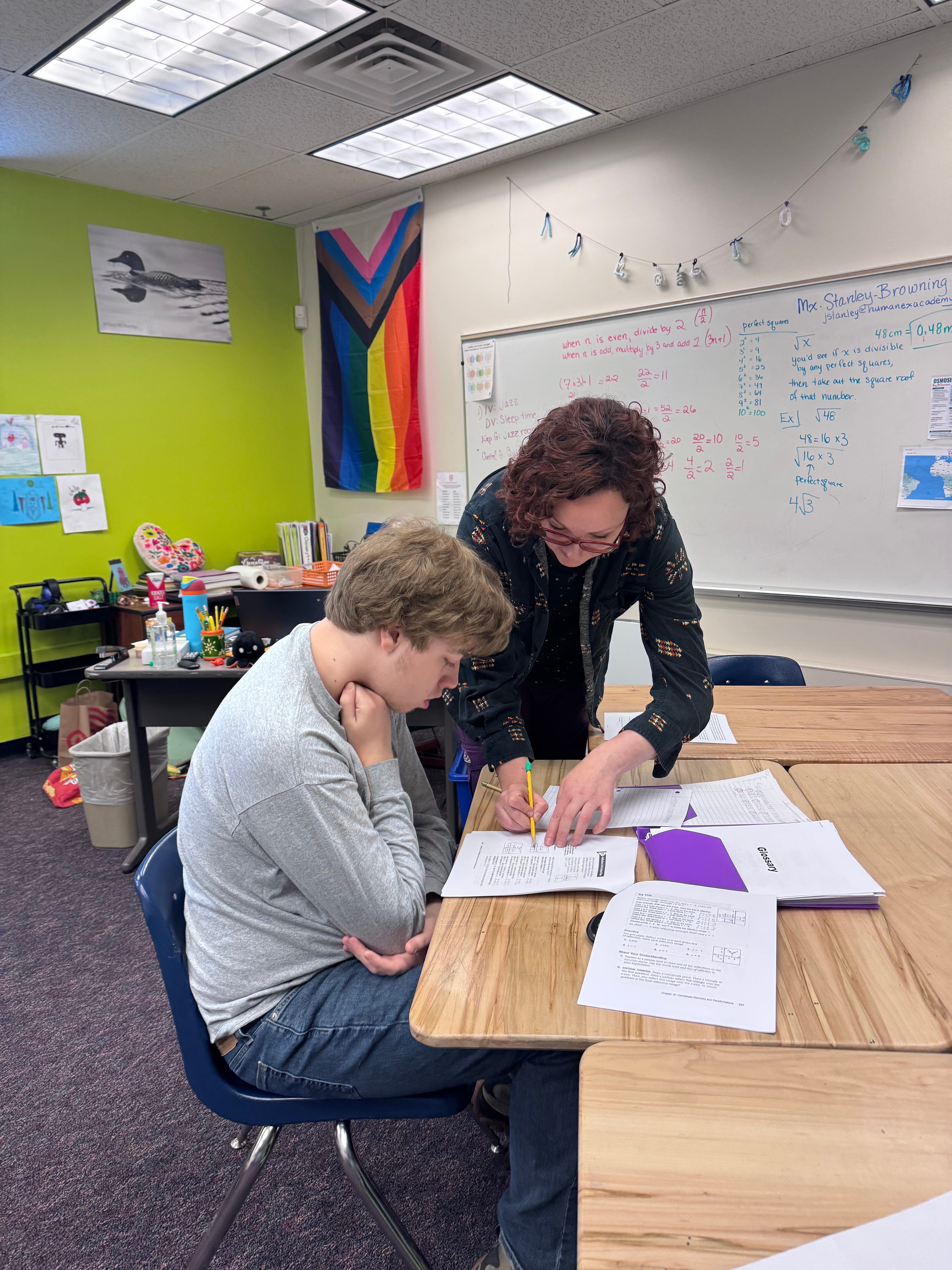
Meeting the expectation looks different for every student. For some, it may mean mastering a complex multi-step equation in Mx. Stanley-Browning’s class; for another, it may mean finding the courage to speak up in a group discussion in Mr. Rosenberg’s classroom or at the lunch table with peers. Equity means recognizing that while the goal is growth for everyone, the starting lines and the hurdles are different for each student. We meet students where they are, providing the specific support they need to reach a standard of personal excellence that is both rigorous and attainable.
Over the last two weeks, our student body has been completing True Progress assessments in the area of Math and ELA. In many traditional settings, standardized tests mean long, grueling days that disrupt schedules, spike anxiety, and measure kids against one another on a rigid curve.
That is never our approach.
True Progress distills benchmark assessments into 30 questions, allowing students to finish their assessment in one class period. This prevents the testing fatigue that often halts actual learning, allowing us to capture a genuine snapshot of a student in the moment. We then layer these snapshots with other data points to honor each student’s individual journey, never ranking them with their peers or others. In a world that often tries to force a linear narrative onto the messy process of learning, we recognize that growth is rarely a straight line.
The most profound learning happens in the organic moments: the social-emotional breakthroughs when a student can connect why they responded the way they did in the moment, the building of resilience through trial and error, and the ability for a student to eventually set their own “expectations.”
When students are merely tasked with meeting an external expectation, the effort is often driven by compliance. When they are challenged to raise the expectation, the effort becomes driven by agency. We move from “What does the teacher want?” to “What is the best quality work I am capable of producing today?” An expectation isn’t set in stone; it’s a moving target. When a student doesn’t meet an ambitious goal, the response isn’t failure, but: “You haven’t met this expectation yet.”
This April, we focus on defining what excellence looks like for each individual student today, and what it could look like tomorrow. The expectation is not the destination; it is the starting line for continuous growth.
 | A guest post by
|